

Skin School · 8 min read
Microneedling 101: why tiny channels build stronger skin
August 11, 2026
Microneedling doesn't add anything to your skin. It wakes up cells that stopped showing up for work and gives them a reason to rebuild, using materials your body makes itself.
Let's start with the part that sounds unhinged.
The entire premise of microneedling is that we poke thousands of tiny holes in your face on purpose, and your skin comes out of it stronger than it went in.
Said out loud, that's a hard sell. Said in the gym, it's just Tuesday. Nobody thinks it's strange that lifting a heavy thing creates microscopic tears in muscle fiber and that the repair is where the strength comes from. Skin runs on the same logic. It just doesn't get talked about that way.
So here's what's actually happening under there, minus the brochure language.
First, why your skin needs the prompt at all
Collagen is the scaffolding. It's what makes skin firm, bouncy, and quick to snap back when you pinch it.
The problem is that you're on a slow withdrawal schedule. A study that measured collagen density across 148 people aged 15 to 93 found it declines in a fairly straight line at roughly 1 percent per year through adult life, at the same rate for men and women.
One percent sounds like nothing. Compound it across fifteen years and it's the reason your skin at 38 behaves differently than it did at 23, even if your routine hasn't changed a bit.
Your fibroblasts, the cells that manufacture collagen, aren't broken. They're just idle. They need a reason to get to work.
Microneedling is the reason.
What actually happens in those twenty minutes
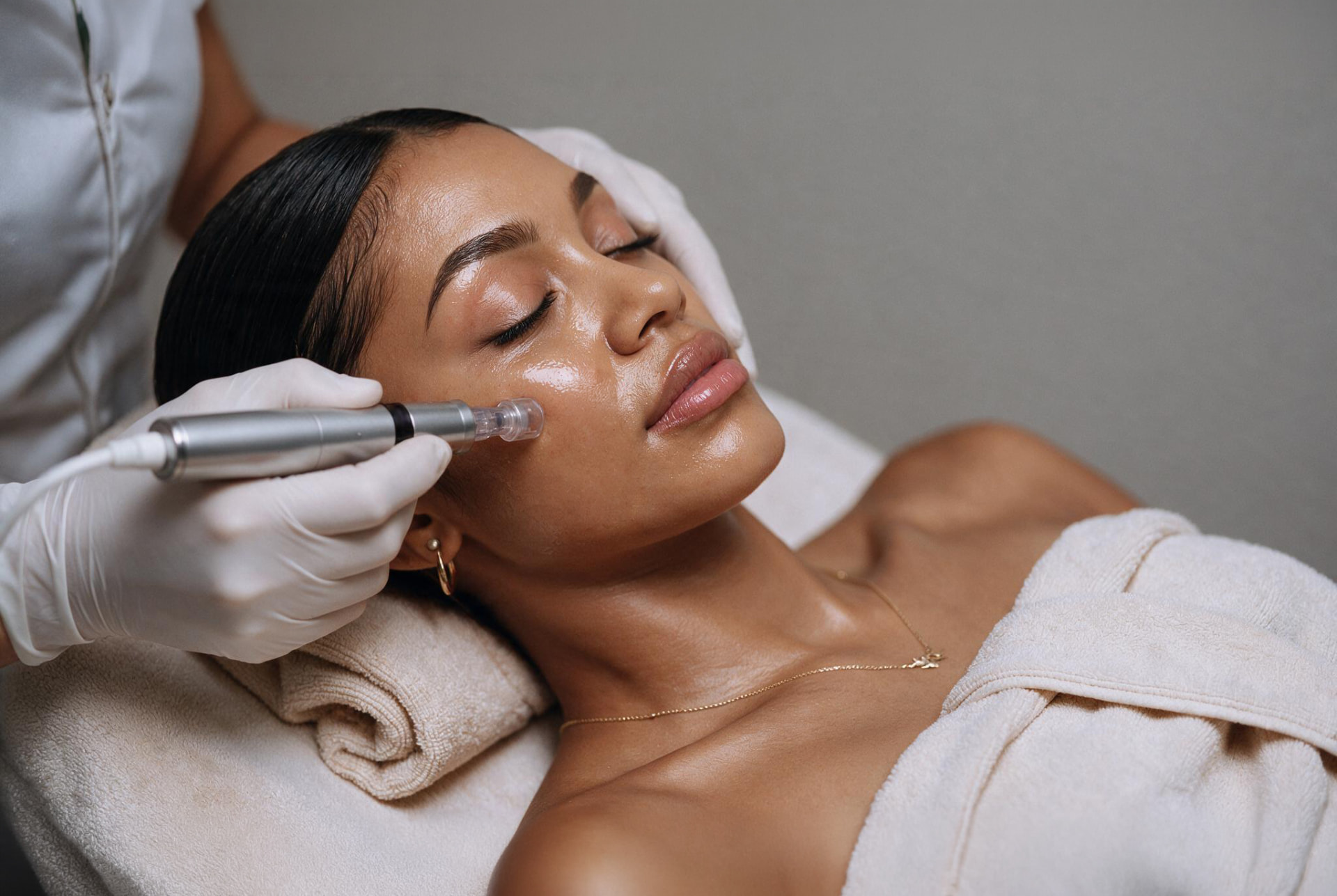
A medical grade device passes over the skin creating a dense, scattered field of tiny channels across your skin.
Two details matter enormously here, and almost nobody mentions them.
The epidermis is punctured, not removed. This is the whole reason microneedling is different from ablative laser resurfacing. Lasers take the top layer off. Needles pass through it and leave it structurally intact, which is why downtime is measured in a day or two rather than a week or two, and why the treatment can be safely repeated.
The channels close on their own, but not instantly. In a study of 111 people, researchers tracked how long micropores stayed measurably open and found an average lifetime between 44 and 66.5 hours, with meaningful differences by skin type. Black participants averaged 66.5 hours, White participants 50.2, Asian participants 44.1.
Read that again, because it's genuinely useful: your skin type changes the biology of your recovery window. Not a marketing line. A measured difference. It's one of several reasons a good plan is built for your skin rather than copied off a menu.
The channels aren't the point. The alarm is.
Here's the reframe we want you to think about, we think that it makes the whole thing click.
Your skin is not repairing the holes. The holes are trivial and they close on their own. What the holes do is trigger a wound-healing cascade that is wildly disproportionate to the actual injury.
It runs in three stages:
Inflammation. Platelets show up and release signaling chemicals. This is the redness. It is supposed to happen.
Proliferation. Macrophages flood in and release a stack of growth factors, including platelet-derived growth factor and transforming growth factors alpha and beta. These recruit fibroblasts and tell them to multiply and get building.
Remodeling. Fibroblasts lay down new collagen, and this stage runs for months, not days.
You called the fire department for a candle, and they showed up and renovated the whole floor. That's microneedling.
And there's a sequencing detail that explains why patience is the actual active ingredient. The first collagen your body lays down is type III, which is the fast, temporary version. Over the following year or more, your body gradually converts it into type I, the dense, structural kind. Once type I is in place, it persists.
That's the payoff. You're not renting a glow. You're depositing structure.
Stronger is not a vibe. It's measurable.
This is where microneedling separates itself from most of the skincare aisle, because researchers have taken actual tissue samples and counted.
In that same study, ten patients were treated six times over three months, with biopsies at baseline and at the end. What changed:
Epidermal thickness went from 63 to 80.2 micrometers.
Type I collagen rose from 67.1 to 78.2 percent of the measured dermal area.
Type III collagen rose from 61.4 to 74.3 percent.
Total elastin decreased while tropoelastin, the precursor to new elastin, increased. Translation: old, degraded elastic fiber being traded in for freshly built stock.
A separate study following patients for a full year after treatment reported roughly a 40 percent increase in epidermal thickness with normalized rete ridges, the wavy interlock between your skin's layers that flattens out as skin ages.
Thicker. Denser. Better anchored. That's not a nicer surface. That's a stronger structure.
The honest limits, because you deserve them
Three things a good coach tells you upfront.
It is not a one-and-done. In the study above, the changes measured after two sessions were not statistically significant. After six, all of them were. The reps are the treatment, not the loyalty program.
It doesn't erase everything equally. Rolling and boxcar acne scars responded well. Icepick scars responded moderately. The deepest atrophic scars responded poorly. Anyone promising you a clean sweep is selling, not assessing.
It isn't right for every skin on every day. Active, inflamed breakouts, recent injectables or lasers in the area, retinoids in the last stretch, pregnancy. All real reasons to wait, and all things our nurses screen for before every single session, not just your first.
The short version
Microneedling doesn't add anything to your skin. It doesn't fill, freeze, or coat.
It wakes up cells that stopped showing up for work and gives them a reason to rebuild, using materials your body makes itself. The channels close in a couple of days. The collagen stays.
That's the trick, and it's a good one.
Curious where your skin would start? Book a consult, or Text Concierge anything.
Next up
Get your reps in: why frequency matters in microneedling
Microneedling doesn't work by making a big change in one appointment. It works by asking your skin to rebuild itself, over and over, until the rebuilding compounds.
Skin School · 6 min read
Still have questions?
Ready to build a plan you can actually stick to? Book a consult, or ask our concierge anything.
Text a human
On it. Opening a text to our team now — tell them what's on your mind and they'll take it from here. If it doesn't open automatically, our number's right here.