


Skin School · 6 min read
Get your reps in: why frequency matters in microneedling
August 10, 2026

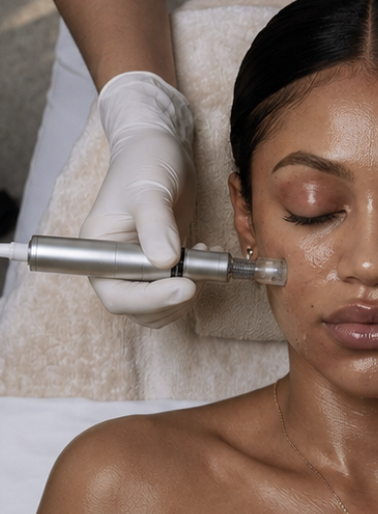
Microneedling doesn't work by making a big change in one appointment. It works by asking your skin to rebuild itself, over and over, until the rebuilding compounds.
You already know how this goes. You buy the membership in January, you go hard for three weeks, and by mid-February the gym bag is a piece of furniture.
It isn't a character flaw. It's math. Researchers tracked 7,752 health club members over three years and found that people forecast 9.5 gym visits a month and actually make 4.17. We are, as a species, wildly optimistic about our own consistency.
Skin is no different. Everyone wants the one session that changes everything.
Here's the honest version: microneedling doesn't work by making a big change in one appointment. It works by asking your skin to rebuild itself, over and over, until the rebuilding compounds into something you can see in the mirror.
And there's a study that shows this almost too perfectly. Keep reading, because the number that matters isn't the one you'd expect.
One: The science says the reps are the treatment
Quick recap. Microneedling creates thousands of tiny, controlled channels in the skin. Your body reads those channels as an injury and starts a repair sequence: inflammation first, then proliferation, then remodeling, where new collagen is laid down, matured, and reorganized. That remodeling phase runs for weeks after a single session, not hours.
Now the study.
Ten patients with atrophic acne scarring were treated six times over three months, with biopsies taken at baseline, at one month, and at three months. Not photos. Actual tissue.
After two sessions, the collagen changes were not statistically significant. Type I collagen had nudged up. Type III had nudged up. Newly formed collagen had nudged up. All of it sat inside the margin of error. Patients reported a mild 15 to 20 percent improvement in scar appearance and said they were moderately satisfied.
After six sessions, every single one of those markers crossed into statistical significance. Type I collagen climbed from 67.1 to 78.2 percent. Type III from 61.4 to 74.3 percent. Epidermal thickness went from 63 to 80 micrometers. Scar improvement was rated 51 to 60 percent, and patient satisfaction jumped to 80 to 85 percent.
Same treatment. Same needle. Same skin. The only variable was reps.
That is the whole argument, and it's the same argument your trainer makes. A single resistance training session elevates muscle protein synthesis for 24 to 48 hours, and then the effect fades. One workout is not a physique. It's a signal. Ten workouts is an adaptation.
Your skin is running the same play. Each session is a signal. Consistency is what turns signals into structure.
Two: What actually changes between session one and session six
The biology is only half of it. The other half is practice, and this is the part almost nobody explains.
Coverage is fractional by design. Microneedling is not a resurfacing treatment that touches every cell. It creates a scattered field of channels with untouched skin deliberately left in between, which is exactly why recovery is fast and the epidermis stays intact. A classic dermaroller study put the density at roughly 250 punctures per square centimeter. Dense enough to trigger a full-field healing response, sparse enough that the skin between the dots is doing the healing.
Which means the specific dots from your first session are not the same dots as your second. Or your fifth. Over a series, those fields layer and overlap, and the areas that got a lighter touch one month get a direct hit the next. You aren't repeating the same treatment. You're filling in the map.
Your nurse gets to actually coach. This is the part a single appointment can never give you. By session three, your nurse has watched how your skin flushes, how fast it settles, how it's responding in the areas you care about most, and can adjust depth, density, and focus accordingly. That matters, because response is not uniform. In the study above, rolling and boxcar scars responded well, icepick scars only moderately, and the deepest scars responded poorly. Nobody can predict which camp you're in from a consultation chair. They find out by treating you and then looking again.
Every session is another delivery window. Those channels stay open briefly after treatment, and while they're open, the skin's normal barrier is bypassed. Studies of microneedle-assisted delivery have shown peptide penetration improving somewhere between 2-fold and 22-fold compared with applying the same thing to intact skin. A serum on top of unbroken skin and the same serum during a treatment are not the same event. More sessions means more of those windows, and more chances to layer in the boosters and finishes that suit where your skin is right now.
Three: So how often, really?
Depends on the depth, and depends on the goal.
Maintenance work, roughly every 4 weeks. Lower-depth sessions are designed to be repeatable. The skin recovers quickly, and monthly is the rhythm most maintenance protocols land on.
Deeper, corrective work, every 4 to 6 weeks. Deeper needling means a longer remodeling cycle, so the gap between sessions is the point rather than an inconvenience. Clinical protocols for scarring and wrinkles typically run a series of 3 to 6 sessions at 4 to 6 week intervals.
And no, more often is not better. Treating again before the previous cycle finishes doesn't accelerate anything. It swaps productive healing for chronic inflammation, which is the skin equivalent of training the same muscle group every day and wondering why you're getting smaller.
Now the goals, because they're not the same job:
Glow and general texture. This is your first-session win. Most people see a healthier surface and smoother feel within one to two weeks of a single treatment, with more visible change through weeks 4 to 6 as collagen remodels.
Acne scarring. This is a series, full stop. Published protocols commonly run 3 to 6 sessions, and as the study above showed, session two is where you feel it and session six is where it measures. Deeper and icepick scarring may need a longer plan and sometimes benefits from being combined with other approaches.
Long-term firmness and tone. This is a practice, not a project. The collagen you build has to be maintained the same way strength is.
The plan isn't one-size-fits-all, and it shouldn't be. That's what the consult is for.
Four: The reps only work if you can afford to take them
Here's the thing that bothers us about this category.
The science is not controversial. Everyone in aesthetics knows that a series beats a single session. And then most clinics price single sessions in a way that makes the series feel like a luxury purchase you have to justify twice a year.
That's backwards. If the treatment only works with consistency, then consistency is the product. Not the upsell.
The Dot Theory exists to make the reps sustainable. Same clinical standard, same nurse-led care, structured so that showing up monthly is a normal part of your routine rather than a quarterly splurge you talk yourself into. Because the woman who does six sessions at a fair price will always beat the woman who does one session at a spectacular one.
So whether you're chasing something specific or just holding the ground you've already gained, the instruction is the same, and it's the least glamorous advice in skincare:
Show up. Rest. Show up again.
Strong skin is built, not bought.
Start here if you're new
Microneedling 101: why tiny channels build stronger skin
Microneedling doesn't add anything to your skin. It wakes up cells that stopped showing up for work and gives them a reason to rebuild, using materials your body makes itself.
Skin School · 8 min read
Still have questions?
Ready to build a plan you can actually stick to? Book a consult, or ask our concierge anything.
Text a human
On it. Opening a text to our team now — tell them what's on your mind and they'll take it from here. If it doesn't open automatically, our number's right here.