

Treatments · 9 min read
"What about down there?" A straight read on intimate rejuvenation
Updated August 12, 2026
Search this question and almost every result is written by a clinic that sells the answer. We don't treat this area, so here's the actual state of the evidence: what's promising, what's thin, and what to rule out first.
Search this question and almost every result is written by a clinic that sells the answer. That doesn't make them wrong. It does mean the conclusion was decided before the research was cited.
We treat the face, the décolleté, and the body. We don't treat this area. So this page has nothing riding on where you land.
What follows is the actual state of the evidence: what's genuinely promising, what's genuinely thin, and what you should have ruled out before you consider any of it.
First, the anatomy, because the words get used wrong
Almost every version of this conversation collapses two different tissues into one.
The vulva is the external structure: the mons, the labia majora and minora, the clitoral hood, the vestibule. The outer surfaces are keratinized skin, structurally closer to the skin on your arm than most people assume, though thinner and with a very different density of glands and nerve endings.
The vagina is the internal canal, lined with non-keratinized mucous membrane. No stratum corneum, which is the barrier layer that governs how the rest of your skin behaves. Different microbiome, different pH, different healing profile, dramatically more permeable.
Nearly everything sold as "vaginal rejuvenation" is external, vulvar, or at most at the vestibule. That's not a pedantic distinction. It's the entire risk calculation, and it's also why studies in this space are so hard to compare: half of them aren't treating the same tissue.
Why our own logic doesn't transfer here
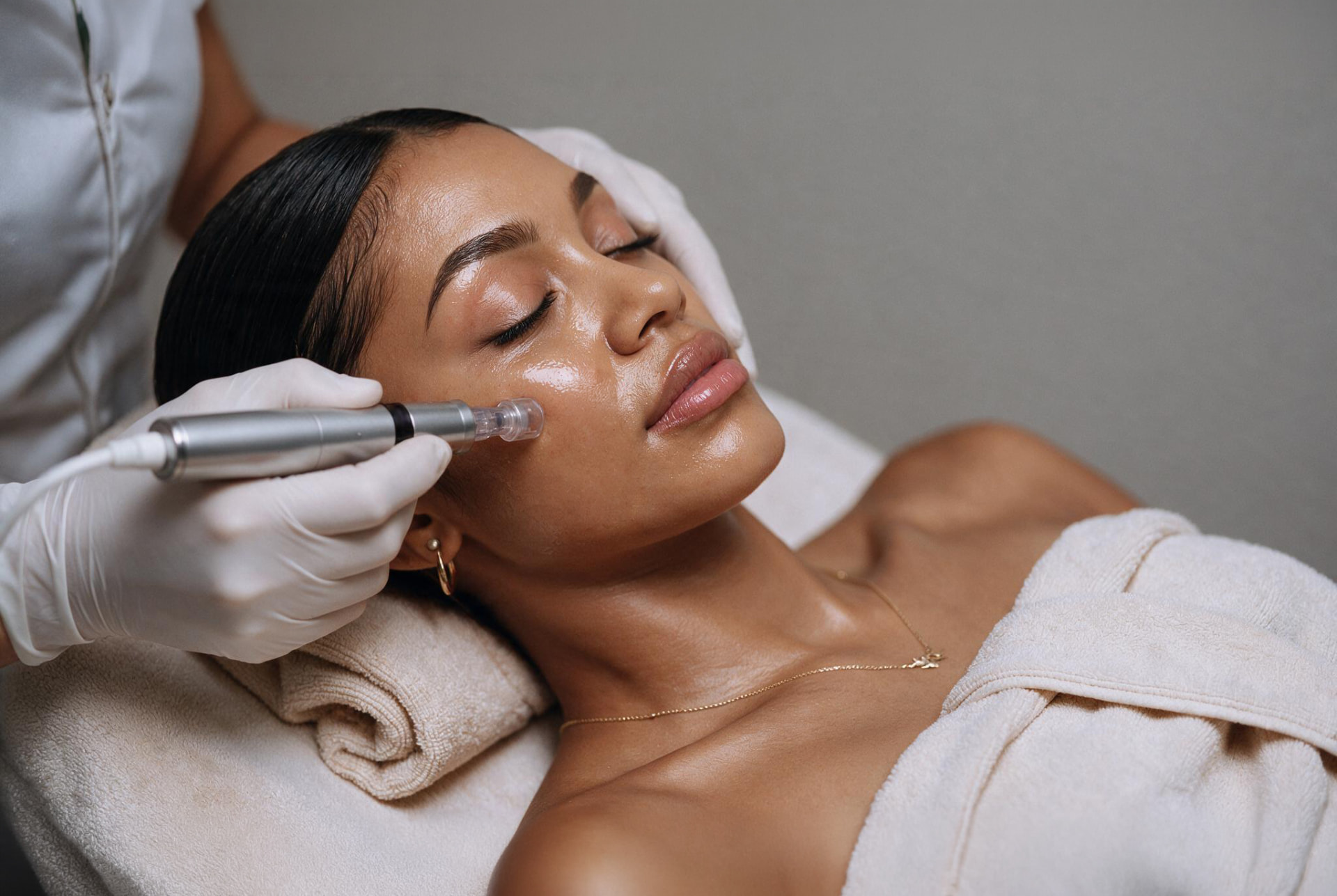
We talk about skin like it's trainable, because on the face it genuinely is. Controlled, survivable injury in tissue that heals predictably, and the repair leaves you stronger. We walked through that whole cascade in Microneedling 101.
Three things break the predictability in this region.
The barrier is different, so absorption is different. On the face, the outer layer limits how much of anything gets into you. On mucosa, that layer isn't there in the same form. Numbing agents are where this bites. The FDA has issued repeated warnings about topical anesthetics over large or broken areas, including a public health advisory prompted by the deaths of two women who used topical anesthetics before laser hair removal. Absorption climbs further when the barrier is already compromised.
Nerve density isn't comparable. Comfort management that's routine on a face is a different conversation in one of the most densely innervated regions of the body.
Hormones are running the system. Estrogen drives the thickness, elasticity, and lubrication of this tissue. After menopause, while breastfeeding, or on certain medications, it's genuinely thinner and more fragile. And that hormonal state is usually the cause of the symptom being treated, which means a surface treatment is working downstream of the actual problem.
What's actually on offer, and what's behind each one
Four things get grouped together under "intimate rejuvenation." They're not equivalent, and the evidence behind them isn't either.
Microneedling
There is direct evidence, and it's more interesting than most people assume.
A randomized study put 30 postmenopausal women into two groups: fractional radiofrequency or microneedling with a dermaroller, on vulvar tissue, with biopsies. Both groups showed higher type III collagen and vimentin expression on immunohistochemical analysis, and both were effective for flaccidity of the external genitalia, with no superiority between the techniques.
That's a real finding with tissue behind it. It's also 30 women, split into groups of 15, with no untreated control arm and a short follow-up. It tells you the mechanism appears to work in vulvar tissue. It doesn't tell you how durable it is, who it's best for, or how it compares to doing nothing.
Verdict: plausible mechanism, genuine early data, nowhere near enough of it.
PRP (platelet-rich plasma)
The most studied of the four, and still not well studied.
The most recent systematic review, covering literature through October 2024, concluded that PRP injections in the vulvovaginal area may offer clinical benefits across several indications with a favorable safety profile, but that high variability in protocols, small sample sizes, and methodological limitations preclude definitive conclusions. An earlier review focused on genitourinary syndrome of menopause reached the same shape of answer: a promising, patient-friendly option worth considering for patients who can't use hormonal therapy, but with a limited evidence base and randomized trials still needed.
Worth knowing: the branded versions, the O-Shot and V-Shot, are patented, and were commercialized despite a relative paucity of data. The marketing arrived before the trials did. That's not disqualifying, but it should shape how you read the claims.
Verdict: the safety signal is reassuring. The efficacy signal is real but unresolved.
PRF (platelet-rich fibrin)
Newer, and thinner.
A study applying injectable PRF to the posterior vaginal wall in postmenopausal women with GSM, in two sessions a month apart, tracked sexual function and quality of life at one and six months. The authors noted plainly that they could find no published study of locally administered i-PRF for GSM before their own.
When a paper opens by saying nobody has done this before, that's your evidence base.
Verdict: earliest stage of the four. Interesting, not established.
Biofillers and hyaluronic acid
The strongest data set here, with the biggest asterisk.
The ESOLANE study followed 72 women treated with cross-linked HA in the labia majora for a full year. Ninety-seven percent rated themselves improved at 12 weeks, with improvement rates staying above 92% through 52 weeks and investigator ratings above 86%. Sexual function scores improved significantly at every timepoint, and symptoms of irritation, burning, and itching dropped from baseline through week 52.
On the collagen question specifically, HA isn't only a volumizer. A study in human vaginal mucosa found cross-linked HA stimulated CoL1A1 and CoL3A1 gene expression at 8 weeks, suggesting collagen formation, and the filler effect itself lasts around 12 months before resorbing.
Now the asterisks, and there are several.
The study was prospective and multicenter, but uncontrolled and open-label, with no blinded evaluators. The authors named this themselves, noting a randomized controlled trial is the gold standard and wasn't feasible here. It was funded by the manufacturer, and all authors had contracts with them. Fifteen percent of patients had a treatment-related adverse event; most were mild and resolved within 8 days, but three patients had events lasting over 30 days, including one with injection site pain for 130 days.
And the line that deserves the most weight, from the study's own authors: the product should be used only within its licensed indication, and is not a first-line or mainstream treatment for female sexual dysfunction or genitourinary syndrome of menopause.
The researchers were more cautious about their own product than most clinics selling it. One more thing for a US reader: the device in that study is CE-marked in Europe, and regulatory status differs by country. Approval where a study was run doesn't tell you the status where you live.
Verdict: the best evidence of the four for appearance and comfort. Still not first-line for the medical symptoms most people are actually chasing.
The pattern worth noticing
Read all four together and the same shape appears every time. Small samples. Short follow-up. Missing control groups. Combination protocols that make it impossible to say which part worked. Industry money. And a marketing layer that runs several years ahead of the research layer.
The regulatory record makes the same point. In July 2018 the FDA warned that energy-based devices for vaginal "rejuvenation" may be associated with serious adverse events, and that safety and effectiveness for these conditions has not been established, citing reports of burns, scarring, pain during intercourse, and chronic pain. The agency also flagged the imprecision of the term "vaginal rejuvenation" itself.
Different devices from the ones above. Same category culture.
None of this means these treatments don't work. It means the confidence in the marketing isn't yet earned by the data, and you're entitled to know which is which before you decide.
What to rule out first
Almost nobody researches this out of curiosity. There's usually a specific thing going on, and for most of them the best-evidenced answer isn't a procedure.
Dryness, burning, discomfort, pain with sex. Most often genitourinary syndrome of menopause, and not a niche problem: GSM affects roughly 27% to 84% of postmenopausal women, is likely underdiagnosed and undertreated, and in most cases symptoms can be effectively managed. It isn't menopause-only either: the same low-estrogen state occurs during lactation, with hypothalamic amenorrhea, and on antiestrogen therapies for breast cancer, fibroids, or endometriosis. Local estrogen therapy and non-hormonal moisturizers have a substantial evidence base. That's the starting line.
Leaking, laxity, changes after childbirth. Pelvic floor muscle training has the strongest evidence of anything in this article, and it gets skipped constantly for something that sounds more advanced. A Cochrane review found women with stress urinary incontinence doing pelvic floor muscle training were about eight times more likely to report cure than controls, 56% versus 6%, rated high-quality evidence. Eight times, from an exercise program, at high certainty. Nothing else on this page comes close to that number.
Concerns about size, shape, or color. The normal range is enormous. A 2026 meta-analysis of seven studies and 991 women found average labia minora length varying from 36.5 mm to 60.6 mm across studies, with marked variability between individuals and wide overlapping ranges. Asymmetry is standard. A great deal of the distress in this category is manufactured by images that aren't representative of anything.
Itching, burning, bleeding, a new lesion, or a texture change. These are not cosmetic questions, and this is the one to get right. Lichen sclerosus is chronic, treatable, and badly underdiagnosed. Diagnosis is often delayed by 5 to 15 years, and it's commonly misdiagnosed as thrush or as ordinary menopausal change. Untreated it can scar and carries elevated cancer risk. Treated, relief from topical corticosteroids is often quick, usually within a month.
Years to name. Weeks to treat. That gap is the single best argument on this page for getting a diagnosis before you get a procedure.
The risks, stated plainly
Infection. Warm, moist, and home to a resident microbiome you don't want introduced below the surface.
Unpredictable healing. Hormonally thinned tissue doesn't repair on the schedule facial protocols assume.
Scarring. Here, scarring can mean lasting pain rather than an appearance change. Different category of consequence.
Anesthetic absorption. Covered above, and the risk most likely to be underestimated.
Treating the wrong thing. A cosmetic procedure performed on top of an undiagnosed dermatological condition can make it worse.
Operator variability. With protocols this unstandardized, who performs it matters more than which treatment it is.
And one that needs no nuance: at-home rollers and needling devices have no business here. Non-sterile, uncontrolled depth, permeable tissue, resident bacteria. There's no version of that which is a good idea.
The short version
There's real science here. Microneedling, PRP, PRF, and HA biofillers all have published data showing collagen changes or symptom relief in this region, and the safety signals so far are mostly reassuring.
There's also a real gap between what the research supports and what the marketing claims, and that gap is where people get hurt.
So the sequence matters more than the choice. Get it looked at and named first. Rule out the conditions that have well-evidenced treatment. Then, if you still want to explore something, you'll be doing it with a diagnosis in hand instead of a symptom and a guess. A physician or gynecologist visit costs you one appointment and rules out the things that actually matter.
That's the honest version. It's the same thing we'd tell you about your face.
Want to talk through what the evidence looks like on anything in here? Text a human on our team. No booking required.
The Dot Theory offers microneedling for the face, décolleté, and body. We do not offer intimate-area treatments, and nothing here is a recommendation for or against one. Our menu reflects where the clinical evidence currently supports treatment; we review it as the research develops. This article is general information, not medical advice, and is not a substitute for evaluation by a physician or gynecologist. Pain, bleeding, new lesions, or changes in texture should be assessed by a clinician.
Start here if you're new
Microneedling 101: why tiny channels build stronger skin
Microneedling doesn't add anything to your skin. It wakes up cells that stopped showing up for work and gives them a reason to rebuild, using materials your body makes itself.
Skin School · 8 min read
Still have questions?
Ready to build a plan you can actually stick to? Book a consult, or ask our concierge anything.
Text a human
On it. Opening a text to our team now — tell them what's on your mind and they'll take it from here. If it doesn't open automatically, our number's right here.