


Treatments · 10 min read
Microneedling for Hair: What It Actually Does (and What It Doesn't)
Updated August 12, 2026
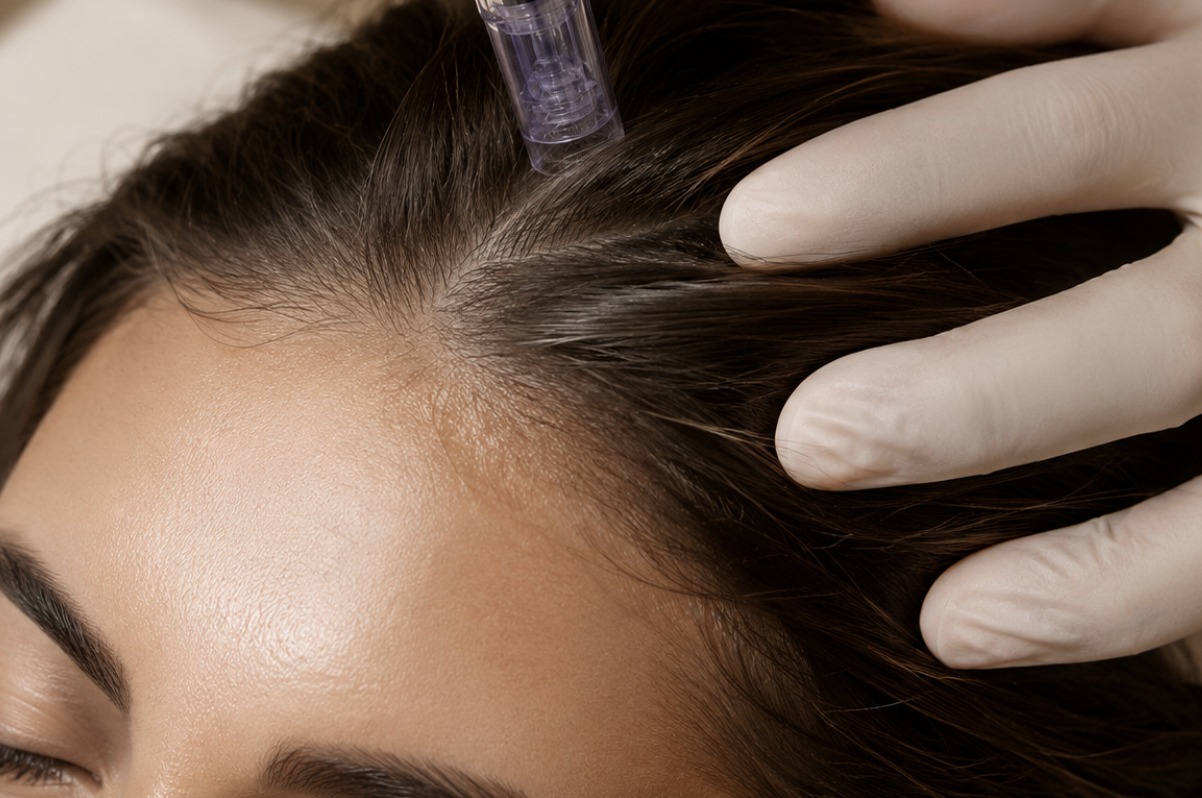
Microneedling the scalp does not grow hair on its own. It changes the environment around the follicle and makes what you put on your scalp work harder.
If you're reading this, something has probably already changed.
A part that reads wider in photos than it does in the mirror. A ponytail that wraps one extra time. A shower drain you didn't used to notice and now check.
And the internet's answer to that is a $30 roller and an enormous amount of confidence.
So here's the version without the confidence: microneedling does not grow hair. It changes the conditions around the follicle, and it makes what you put on your scalp work harder. That's a smaller claim than the ads make. It's also the one the research actually supports, which is why it's the one worth having.
The mechanism is the same one your face uses
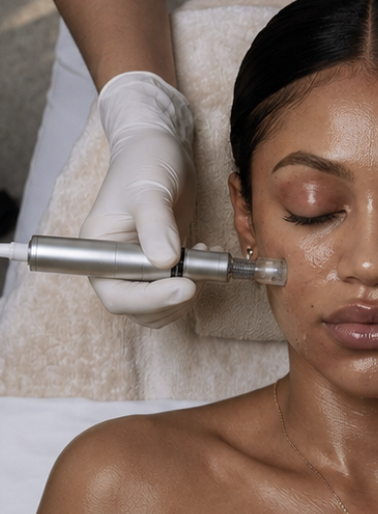
Nothing about the scalp changes the underlying idea. A medical device creates a dense field of tiny channels. Your body reads that as injury and runs the repair sequence: inflammation, then proliferation, then remodeling. If you want the long version, it's the same cascade we walk through in Microneedling 101.
The part that matters for hair is the middle stage.
That repair releases growth factors and pulls blood supply into the area, and hair follicles are unusually responsive to that environment. They live in the dermis, surrounded by the exact tissue you just asked to rebuild itself. The researchers behind the landmark trial framed it around the dermal papilla as the site where hair-growth-related genes are expressed, and microneedling as a way to stimulate stem cells and activate growth factors there (Dhurat et al., International Journal of Trichology, 2013).
You're not needling hair. You're renovating the neighborhood the follicle lives in.
The evidence worth quoting
One study anchors this entire field, and the numbers are genuinely striking.
A hundred men with mild-to-moderate pattern hair loss were randomized into two groups for twelve weeks. Both used 5% minoxidil twice daily. One group added weekly microneedling. Hair was counted in a tattooed one-square-centimeter patch so the same skin was measured every time, and the evaluators were blinded.
The microneedling group gained a mean of 91.4 hairs per square centimeter. The minoxidil-only group gained 22.2. On investigator assessment, 40 patients in the microneedling group scored a +2 to +3 improvement; not one patient in the minoxidil group did. And 82% of the microneedling group reported more than 50% improvement, against 4.5% on minoxidil alone (Dhurat et al., 2013).
Read the framing carefully, because it's the whole point. The finding is not "needles grow hair." The finding is "needles plus a proven topical beats the topical alone, by a lot." Microneedling was the multiplier, not the treatment.
Two honest caveats, because that study gets quoted without them.
It was 100 men aged 20 to 35, over 12 weeks. That's a pilot, not a definitive trial. And when a later randomized study tried to replicate it, the combination still beat minoxidil alone statistically, but those authors described their own result as not cosmetically significant compared with the Dhurat findings (Journal of Cutaneous and Aesthetic Surgery, 2017). The direction replicated. The magnitude didn't. Anyone quoting you "four times better" as a promise is over-reading a pilot.
And since most of the people reading this are women: Dhurat enrolled men only, which matters. A separate randomized trial of 115 women with female pattern hair loss ran three arms over 24 weeks and found hair density increased most in the minoxidil-plus-microneedling group, and epidermal thickness and average follicle diameter increased only in that group (Frontiers in Medicine, 2022). Longer study, both sexes now covered, same direction.
Zoom out and the reviews agree, carefully. A 2024 meta-analysis of 13 randomized trials and 696 patients found combined microneedling significantly improved hair density and diameter versus monotherapy, with good safety (Pei et al., Journal of Cosmetic Dermatology, 2024). An earlier systematic review reached the same conclusion with a sharper edge on it: generally favorable results as an adjunct therapy, no serious adverse events across 657 subjects, but data of relatively low quality with significant heterogeneity across protocols (English et al., Dermatology and Therapy, 2022).
The unglamorous second benefit: delivery
There's a reason your scalp serum feels like it mostly disappears.
The outermost layer of skin is a barrier by design and it's very good at its job. Most of what you apply never gets past it. Microneedling temporarily opens that barrier, and those channels don't close instantly: a study of 111 people found micropores stayed measurably open for an average of 44 to 66.5 hours, varying by skin type (Ogunjimi et al., Scientific Reports, 2020).
So the same product, applied into a scalp that was treated properly, is simply more available to the tissue you were aiming at. That's a mechanical advantage, and it costs nothing extra.
One caveat that gets skipped constantly: better absorption is not selective. It also means better absorption of things you didn't intend. Fragranced products, actives, anything harsh. Treatment day is the day to be boring.
Timelines, honestly
Hair does not respond on a skincare timeline. It responds on a hair cycle, and that cycle is measured in years.
The growth phase runs 2 to 6 years and holds 85% to 90% of your follicles at any moment. The resting phase lasts around three months, after which the old strand sheds (StatPearls, Anatomy, Hair). Any intervention has to wait for follicles to re-enter growth. That's the whole reason nothing visible happens fast.
Twelve weeks is an early read. Six months is a fair one. And the first honest sign of progress usually isn't length, it's less shedding and more short regrowth along the part.
There's also something nobody warns people about: shedding in the first weeks is common, and it is frequently the opposite of failure. Follicles pushed out of a resting phase release the old strand before the new one comes through. It looks like the treatment is making things worse. Often it's the treatment starting to work.
Frequency, and why more is not better
The landmark trial used a weekly cadence at a specific depth. Protocols since have run somewhere between weekly and monthly depending on how deep you go, and that variation is one of the reasons the reviews keep flagging heterogeneity.
The principle is the one we've written about at length in why frequency matters: the reps are the treatment.
But there's a ceiling here, and it's lower than people assume. Treating again before the last round has finished healing trades productive repair for chronic irritation, and an irritated scalp is not a growth environment. This is a discipline problem, not an effort problem.
Where at-home rollers fall down
This isn't gatekeeping. It's three specific failures.
Depth. Rollers apply uneven pressure across a curved skull, so your depth is whatever your hand did that day. Too shallow does nothing. Too deep is a scarring risk, and a scarred follicle doesn't come back.
Sterility. A device that lives in a bathroom and gets used on broken skin is a real infection route. Folliculitis is the common outcome, and it sets you back further than doing nothing would have.
Density and quality. Needle count, sharpness, and consistency vary enormously in consumer devices. Blunt needles tear instead of puncturing, which is a different injury with a different healing response.
The difference between a stimulus and an injury is control. That's the entire product.
Get the cause named first
This is the part we'd want a friend to hear before anything else on this page.
Thinning is a symptom, not a diagnosis. Pattern hair loss, postpartum shedding, thyroid disease, iron deficiency, shedding after illness or major stress, autoimmune causes, medication side effects, and scarring alopecias all present as "my hair is thinner." They do not share a treatment plan.
Some resolve on their own. Some need a physician and a blood panel. And the scarring types are genuinely time-sensitive, because once a follicle is destroyed, no amount of stimulation brings it back.
There's also a practical reason, not just a safety one: microneedling's best evidence is as an adjunct to a proven topical. If you don't know what you're treating, you don't know what to pair it with, and you've removed the half of the protocol that carried most of the result.
So the order is: find out why, then choose the plan. Not the reverse.
The short version
Microneedling the scalp is a credible adjunct with a real mechanism and reasonable evidence behind it, especially alongside a proven topical. It is not a standalone answer. It is slow. And it rewards consistency over intensity, which is the least exciting advice in this entire category and also the correct one.
Same rule as the rest of your skin. Show up, let it heal, show up again.
Not sure where your thinning is coming from? Start there. Text a human on our team if you want to talk it through with a person first.
Studies referenced here are published clinical research, not results from The Dot Theory. Individual outcomes vary by cause of hair loss, sex, age, and treatment protocol. Nothing here is medical advice or a recommendation for any specific product or regimen. Hair loss has many causes, some of them medical; a physician or dermatologist should evaluate persistent or sudden thinning before you begin any treatment.
Start here if you're new
Microneedling 101: why tiny channels build stronger skin
Microneedling doesn't add anything to your skin. It wakes up cells that stopped showing up for work and gives them a reason to rebuild, using materials your body makes itself.
Skin School · 8 min read
Still have questions?
Ready to build a plan you can actually stick to? Book a consult, or ask our concierge anything.
Text a human
On it. Opening a text to our team now — tell them what's on your mind and they'll take it from here. If it doesn't open automatically, our number's right here.